
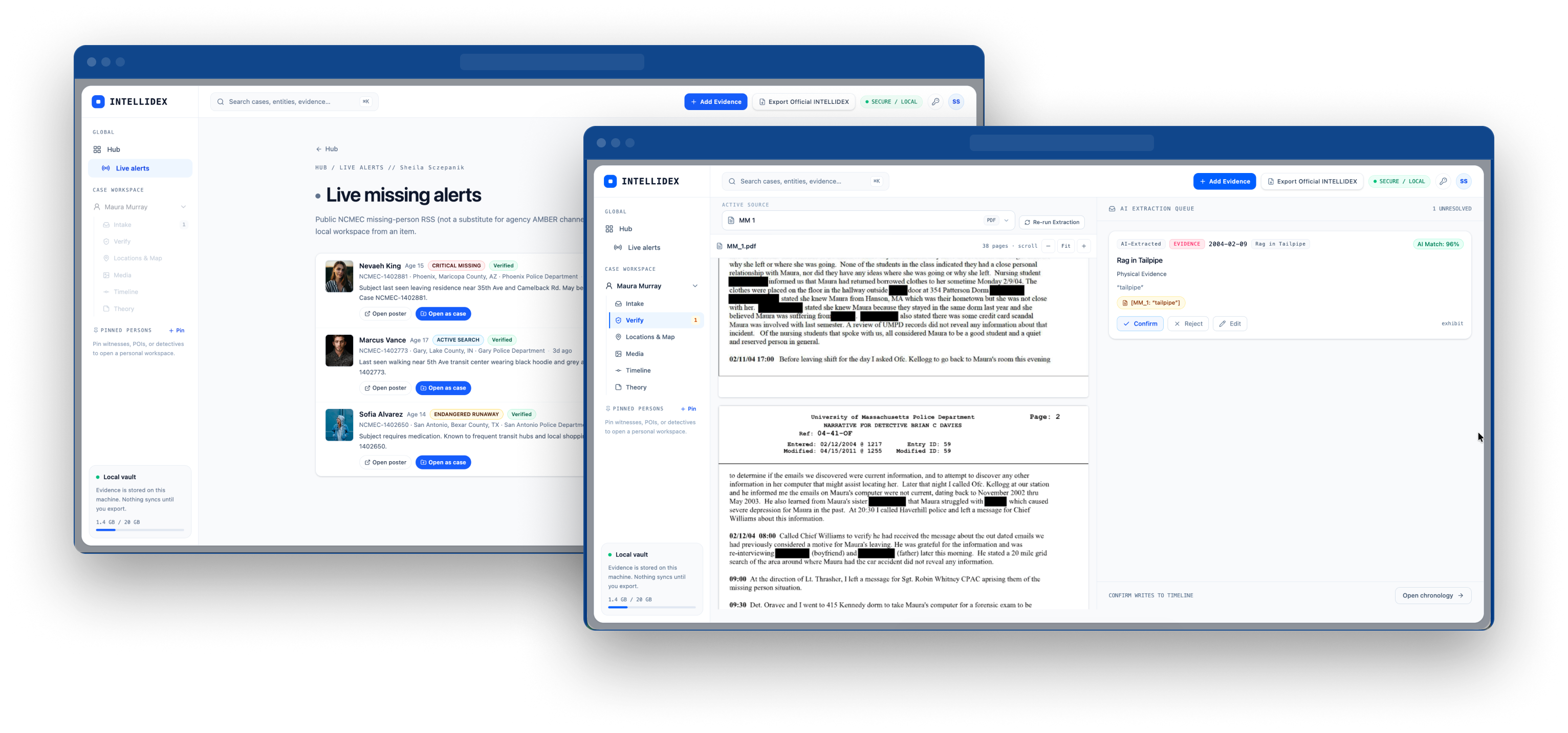
CASE STUDY · INTELLIGENCE PLATFORM · 2026
Intellidex — Long-Term Missing Persons Intelligence Workbench and Cold Case Investigative Platform
⏰
TL;DR
I hear you, lots going on today. Here’s a quick rundown.

ROLE
Lead Product Designer & Systems Architect
Focus Domain
High-Density Investigative Systems, Complex Data Visualization, Cold Case Review
Core Technologies
Figma, React 18, TypeScript, Tailwind CSS, IndexedDB, Playwright, NamUs API
The Core Problem
Why Cold Cases Stall: The Breakdown in Investigative Ergonomics
Traditional law enforcement databases and generic spreadsheet tools fail long-term missing persons investigations across four critical vectors:
01
Unanchored Disappearance Timelines
Investigations hinge on isolating the confirmed Last Known Seen (LKS) window. Standard chronological tools treat all timestamps equally, failing to visually lock and weight the verified LKS anchor against conflicting, unverified post-disappearance leads.
02
Unreconciled Geospatial Sightings
Community tip lines and witness statements produce overlapping, physically impossible sightings (e.g., sightings in distinct cities within the same two-hour window) that remain buried in unstructured text notes rather than triggering automated spatial-temporal conflict flags.
03
Evidentiary Integrity & Zero-Trust Cloud Mandates
Unsealed juvenile records, dental charting, and sensitive family depositions cannot be uploaded to commercial third-party cloud tools without compromising privacy mandates and chain-of-custody protocols.
04
High-Friction Evidence Provenance
Cross-referencing an unverified sighting against original agency logs requires investigators to manually comb through hundreds of non-indexed case scans, creating cognitive fatigue and slowing time-to-lead verification.
Cold case files don't go quiet because people stop caring; they go quiet under the sheer weight of fragmented evidence.
Intellidex was built to bridge this breakdown: pairing zero-trust, local-first data architecture with high-density forensic ergonomics so search teams, detectives, and advocates can cut through decades of noise.
PRODUCT ARCHITECTURE & SYSTEMS STRATEGY
Designing the Investigative Engine from the Ground Up
Standard law enforcement software functions like a digital filing cabinet: built to store compliance records, but completely decoupled from how investigators actually synthesize evidence. Finding correlations across decades of files still defaults to physical paper, highlighters, and memory.
I architected Intellidex around an active investigative mental model. Rather than treating records as static text fields, the system transforms raw case artifacts into an interactive knowledge graph where every insight remains directly anchored to its primary evidentiary source.
Raw Unstructered Data
- Decades-old paper police logs & scanned intake forms
- Unindexed community tip-line call sheets
- NamUs records, physical trait markers & dentition data
Intellidex Core Mechanics
- Bi-directional canvas linking claims to primary scans
- Multi-track witness sighting lanes with timeline collision detection
- Local-first, zero-cloud chain-of-custody data engine
High-Confidence Ground Truth
- LKS-anchored transit corridors and spatial search radiuses
- Auto-flagged spatio-temporal contradictions in witness statements
- Source-traceable, audit-ready case dossiers
Key Features & Design Decisions
Investigative Friction in Cold Missing Persons Inquiries
Interviews and observational audits of cold case investigators and missing persons case auditors revealed four acute operational bottlenecks:
LKS DISORIENTATION
Over decades, the verified Last Known Seen timestamp becomes buried among hundreds of subsequent unverified sightings.
TIP-LINE SATURATION
High volumes of contradictory public sightings obscure the genuine departure window of the missing individual.
GEO-SPATIAL ISOLATION
Sighting addresses, transit corridors, and search grids exist in separate maps away from the written testimony.
UNVERIFIED EXTRACTIONS
Analysts distrust AI extraction summaries unless they can point directly to the physical line on the scanned agency filing.
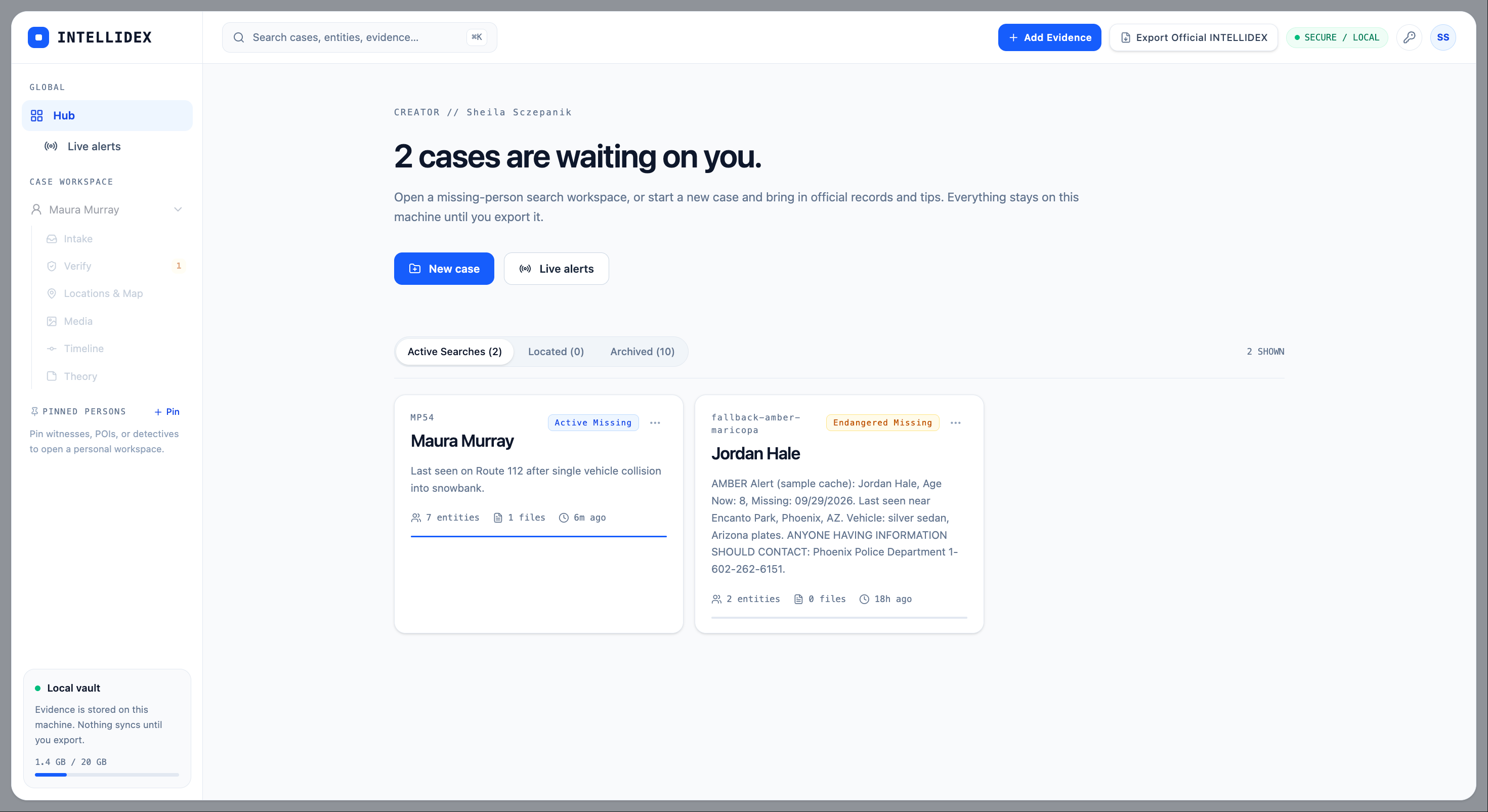
Workspace Hub & Multi-Case Synthesis
Design Rationale
Investigative teams manage multiple concurrent inquiries where evidence develops non-linearly. Traditional folder structures obscure case velocity, forcing analysts to manually check files to see which investigations have stalled or received fresh leads. The Workspace Hub functions as an operational radar, surfacing case velocity, entity density, and local vault integrity before an investigator dives into an individual file.
Interaction Model
Cases are prioritized across triage states (Active, Review, and Cold) using high-density status cards. Investigators can evaluate case momentum through entity counts, indexed artifact volume, and recency indicators. Top-level actions provide immediate pathways for new dossier setup and local JSON/archive ingestion, while the persistent vault monitor reinforces zero-cloud data containment across the session.
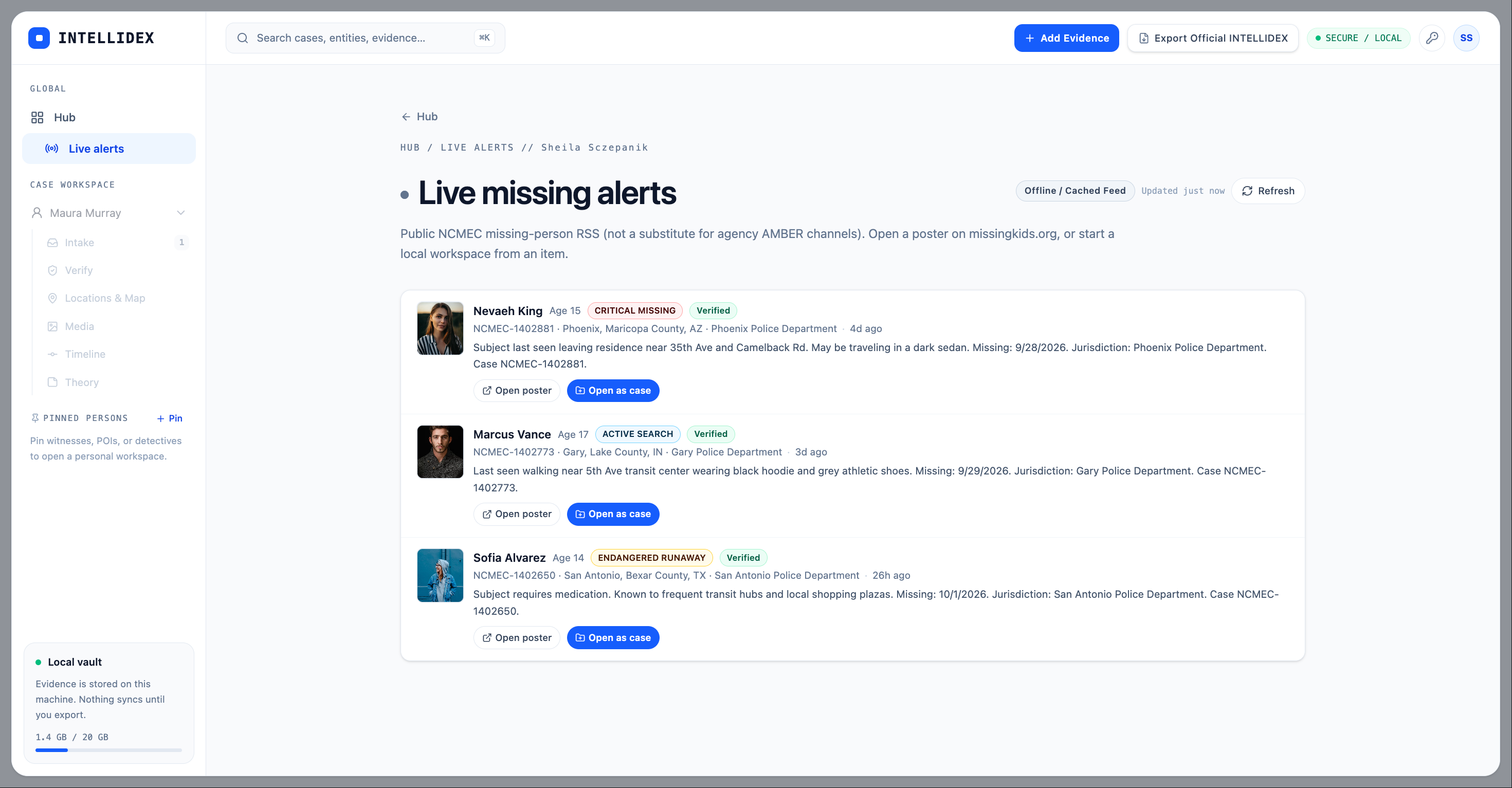
Real-Time Ingestion: Live Missing Alerts & Triage Feed
Design Rationale
When a person disappears, the first 72 hours determine whether critical leads are captured or lost forever. Investigators and search advocates often monitor disconnected public bulletins, NCMEC feeds, and regional agency alerts across multiple browser tabs. This fragmentation slows down early intake and creates friction when standing up a new file.
I designed the Live Alerts feed as a centralized intelligence intake channel. It surfaces real-time missing person broadcasts, provides cached offline resilience, and bridges the gap between public alert feeds and active local casework with one-click conversion.
- Interaction Model
- Streamlined Triage ErgonomicsEach alert card organizes vital forensic markers for rapid scanning: subject name, age, triage status pills (Critical Missing, Active Search, Endangered Runaway), verified authority badges, jurisdiction, and official case IDs (e.g., NCMEC).
- Zero-Friction Workspace Conversion (Open as case)Instead of manually copying metadata into a new database entry, detectives can select Open as case to instantly instantiate a dedicated local dossier. The system automatically pre-populates subject traits, jurisdictional contacts, and initial narrative records into the workspace schema.
- Offline-First Resilience & Cached SyncDesigned for zero-trust environments and spotty connectivity, the engine maintains an encrypted local cache (Offline / Cached Feed). Investigators retain full access to recent alerts, poster assets, and baseline records even when operating off-grid.
INTERACTION ARCHITECTURE & CORE WORKSPACES
Workspace Initialization: NamUs Ingestion & Active Case Instantiation
Starting a missing persons investigation historically involves repetitive administrative setup: re-typing data across agency databases, copying narrative incident summaries, and standardizing physical traits by hand. This manual onboarding delays immediate casework and introduces human error right at the start.
I designed this ingestion view to transform raw public clearinghouse data (such as NamUs and AMBER bulletins) into an active, fully structured workspace with a single click.
Live Prototype: Phase 1 Core Modules Deployed ↗
Note: This is an active, deployed web build validating core evidentiary extraction, local IndexedDB storage, and timeline rendering. Extended query features and advanced graph synthesis are actively rolling out.
Automated Clearinghouse Ingestion
The engine pulls structured records directly from external clearinghouses, parsing unstructured bulletin text into standardized metadata: subject demographics, Last Known Seen coordinates, reporting agency contacts, and case classification tags (e.g., Endangered Missing).
One-Click Workspace Instantiation
Selecting an ingested card transitions the investigator from a global monitoring feed into a dedicated, case-specific workspace (Jordan Hale). The system automatically populates the left navigation hierarchy with pre-configured schemas for intake, verification queues, location mapping, media vaulting, and timeline analysis.
Client-Side Air-Gapping & Local Vault
Ingested records and imported evidence are written directly to the on-device local vault (1.4 GB / 20 GB). Cases remain persistent across browser sessions without transmitting unverified notes, family contact details, or sensitive case files to external cloud servers.
Workspace 01: Interactive Verification & Extraction Engine
Standard forensic reviews force analysts into split-attention fatigue: squinting at low-resolution PDF scans in one window while manually retyping data into database fields in another. This manual handoff introduces transcription drift and breaks evidentiary chain of custody.
To solve this, I designed the side-by-side Verification Lab. It eliminates blind data entry by tightly coupling a structured extraction queue directly to an interactive, coordinate-mapped document viewport.
Bi-Directional Coordinate Mapping
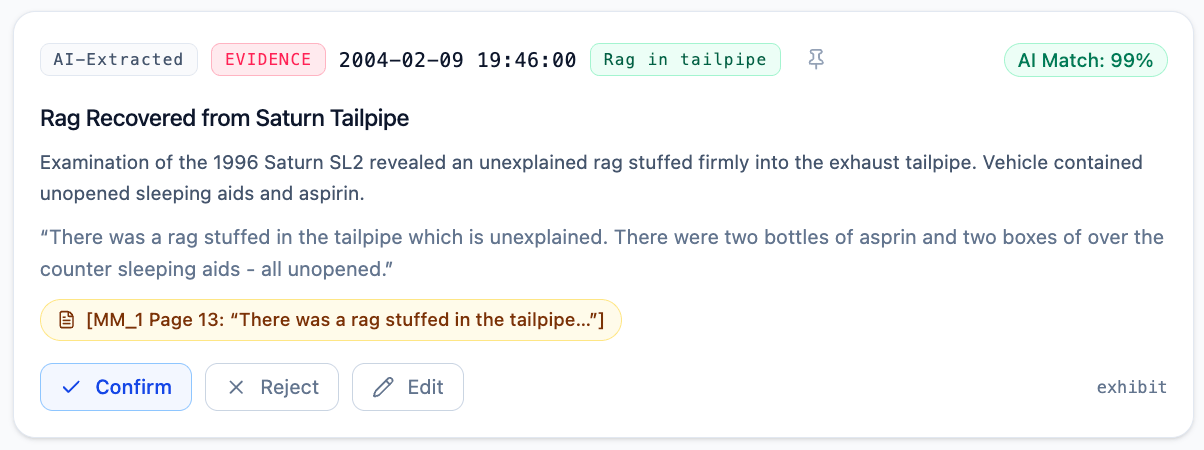
Every extracted card remains tied to its underlying source artifact. Clicking an extracted entity card highlights the exact line coordinate and text segment within the original scanned police log (e.g., MM_1 Page 13: "There was a rag stuffed in the tailpipe..."). Conversely, interacting with highlighted source text on the PDF immediately focuses its paired adjudication card in the queue.
Structured Forensic Normalization & Entity Tagging
Raw narrative text is normalized into structured schemas: classification tags (Evidence, Time, Person), ISO timestamps, and contextual entity anchors (Rag in tailpipe, Saturn Tailpipe). This ensures disparate field logs become queryable, high-density data without losing their original narrative context.
Algorithmic Confidence & Fast-Key Adjudication
Each extracted lead displays an algorithmic confidence score (e.g., AI Match: 99%) derived from OCR clarity and schema validation. Detectives can rapidly confirm, edit, or reject extractions using streamlined inline actions (Confirm, Reject, Edit), ensuring no unvetted claim writes to the active case timeline without human verification.
RAW POLICE LOG
(PAGE 14)
"...at approximately 21:15 hours, subject was observed entering a blue sedan bearing Montana plates heading westbound toward Route 2..."
[ACTIVE CANVAS SYNC]
EXTRACTION VERIFICATION QUEUE
[!] SIGHTING: 1984 Blue Sedan
Timestamp: Oct 24, 1984 · 21:15 MDT
Source: Page 14, Line 18
Confidence: 94% · Needs Detective Review
[Confirm Value] [Correct] [Reject]

Workspace 02: Chronology & Sighting Swimlanes
Traditional timeline tools flatten all events into a single linear feed, treating an unconfirmed community sighting with the same weight as physical video evidence. When dozens of tips flood in, dates overlap, create visual noise, and obscure the critical window of disappearance.
I designed the Chronology Engine to resolve spatial-temporal ambiguity through multi-track swimlanes, automated density management, and fixed evidentiary anchors.
LKS (Last Known Seen) Permanent Anchor
Establishes a locked, persistent milestone across all views that marks the verified date, time, and coordinates of disappearance. It acts as an immovable benchmark, visually separating confirmed pre-disappearance movements from post-disappearance tips and speculative leads.
Four-Tier Operational Swimlanes
Deconstructs chaotic chronological feeds into discrete, parallel tracks to expose patterns at a glance:Track 01: Subject Activity (Pre-Disappearance)Track 02: Witness Sightings & Tip-Line ReportsTrack 03: Persons of Interest & Associate MovementsTrack 04: Official Law Enforcement & Search Grid Operations
Dynamic Badge Collision Resolution
High-density time segments often collapse into unreadable clusters. I implemented a vertical offset algorithm that dynamically staggers dense pill badges based on zoom level, ensuring concurrent entries remain legible without truncating critical metadata.
Spatio-Temporal Contradiction Alerts
The engine actively cross-references sighting locations against elapsed transit times. Conflicting reports (e.g., sightings logged 45 minutes apart in non-contiguous counties) trigger inline contradiction warnings, prompting investigators to test competing hypotheses rather than accepting them as continuous travel.
Workspace 03: Transit Corridors & Media Vault
Investigative leads are rarely just text in a spreadsheet; they are grounded in time, geography, and physical artifacts. When spatial coordinates live in one tool and evidentiary media sits in unindexed folders, investigators lose the context needed to evaluate whether a sighting is plausible.
This workspace bridges geographic analysis with a secure, local media repository to keep visual assets and location data tightly integrated with the core chronology.
Spatial Corridors & Route Analysis
- Chrono-Spatial MappingMaps spatial markers chronologically rather than as a static scatter plot, illustrating potential transit paths moving outward from the Last Known Seen anchor. This enables search teams to calculate reasonable travel times and surface unsearched coverage gaps.
- Evidentiary Coordinate OverlaysSelecting a pinned node surfaces a detailed metadata drawer showing exact coordinates, source provenance (NamUs / Live alert), verification state, and a one-click transition back to the main chronology (View in Chronology).
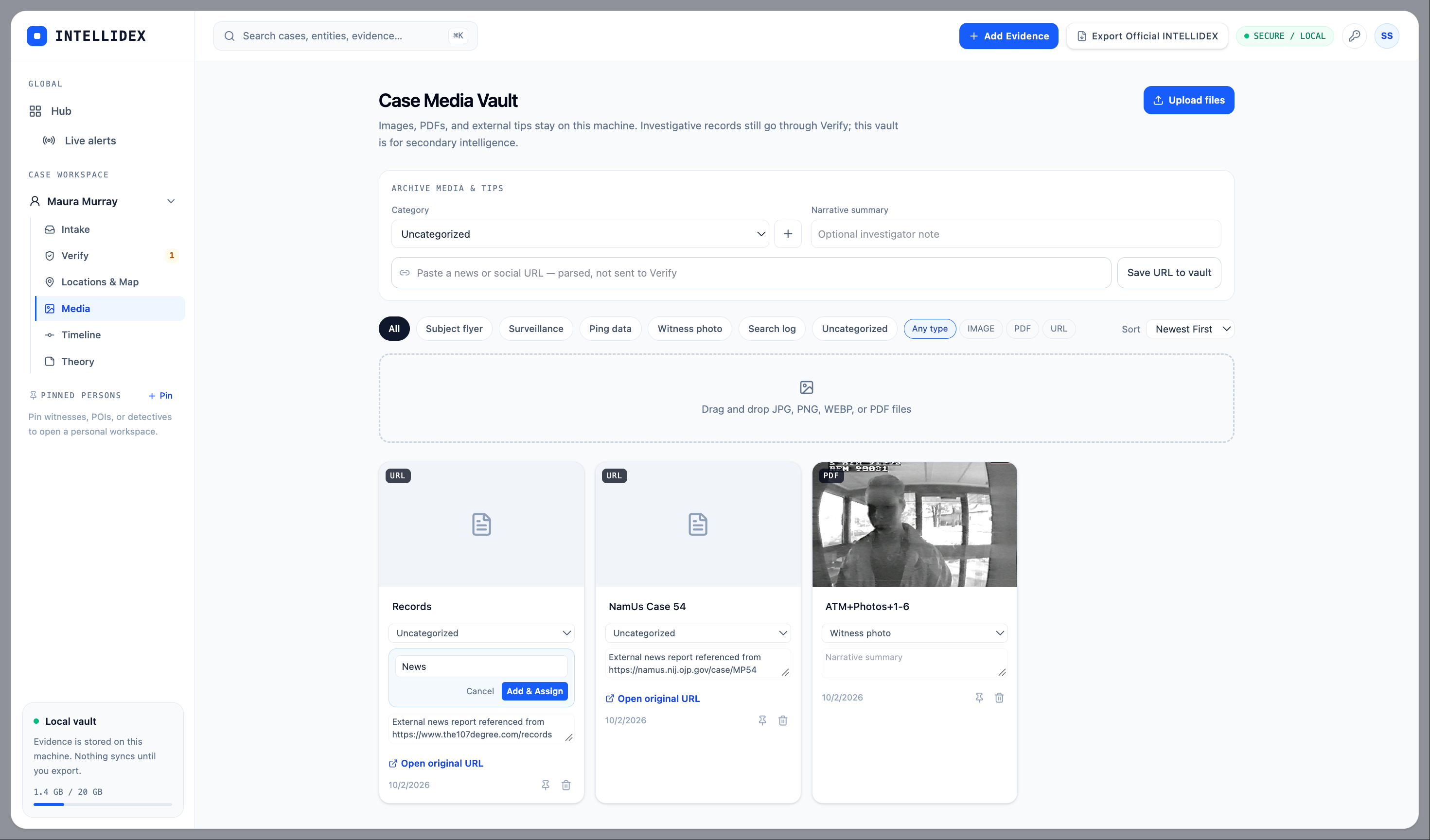
Local Case Media Vault
- Air-Gapped Secondary IntelligenceProvides a secure, on-device vault for secondary media (surveillance stills, ATM footage, missing posters, search logs, and URL references) that preserves evidentiary chain of custody without uploading sensitive files to third-party cloud infrastructure.
- Contextual Media PinningAllows detectives to assign incoming photos, external URLs, and age-progression sketches directly to corresponding geographic checkpoints or persons of interest, ensuring every asset remains linked to a verified case event.
How it was made
Systems Architecture & Technical Execution
T`o stress-test complex temporal interactions, high-density layouts, and offline data persistence, I moved beyond static Figma components and built Intellidex as a fully functional, production-grade application. Merging product design system principles with an AI-assisted frontend engineering workflow allowed me to translate complex forensic mental models into an interactive, testable working environment in days rather than months.
USER WORKSPACE & PRESENTATION
Missing Case Intake | Document | Extraction Lab | LKS Chronology | Person Dossier | Spatial Map

DESIGN SYSTEM & UI FOUNDATION
Semantic Design Tokens • High-Density Component Kits • Accessible Color Systems

AI EXTRACTION PIPELINE
Multimodal Document Parsing
Confidence & Provenance Anchoring
Forensic Schema Normalization
DATA & VAULT GOVERNANCE
Local-First Data Persistence
Zero-Cloud Evidentiary Privacy
Deterministic Local Cache
USABILITY INTEGRITY
Strict Audit Trail Logging
Cross-Surface State Guard
Human-in-the-Loop Review
Critical Challenges Solved
Design & System Challenge
Evidentiary Ingestion Failures (Document Rendering Crashes)
Usability & System Root Cause
Decoded archival scans and degraded PDF case files contained irregular character encodings, causing document viewports to crash during initial upload.
Product Design & AI Resolution
Engineered a robust document-parsing fallback pipeline that sanitizes legacy file structures, ensuring seamless document viewing without data corruption or loss of visual fidelity.
Product Design & AI Resolution
Architected an AI-assisted structured extraction pipeline that transforms raw unstructured page captures into normalized, schema-aligned case profiles ready for review.
Design & System Challenge
Dynamic Data Ingestion Gaps (Real-Time Feed Ingestion)
Usability & System Root Cause
Single-page clearinghouse portals (like NamUs) render data dynamically, causing standard ingestion pipelines to pull blank layouts rather than structured records.
Design & System Challenge
Evidentiary Cross-Contamination (Ghost Bounding Boxes)
Usability & System Root Cause
Switching rapidly between case files caused coordinate highlights and document boundaries to persist across active views, projecting misleading bounding boxes over new files.
Product Design & AI Resolution
Implemented strict context isolation patterns across active document workspaces, ensuring visual coordinates reset completely between cases to preserve evidentiary integrity.
Design & System Challenge
Cognitive Timeline Occlusion (Visual Clumping)
Usability & System Root Cause
Multiple witness sightings submitted for identical timeframes stacked directly on top of each other, cluttering the timeline canvas and hiding critical evidence.
Product Design & AI Resolution
Designed a dynamic layout algorithm with adaptive vertical swimlanes that automatically offsets concurrent badge clusters based on zoom scale, keeping dense evidence legible.
UI PATTERN LIBRARY & DESIGN SPECIFICATIONS
Design Systems and Forensic Ergonomics
Reviewing decades of dense casework requires sustained visual focus under high cognitive load. The design system balances strict information density with visual calm, using tokenized neutral surfaces for structural hierarchy and reserving purposeful semantic hues exclusively for evidentiary status.
Low-Fatigue Layered Canvas:
Avoids pure stark-white backgrounds in favor of layered, low-glare stone and slate surfaces. This grounds high-density data tables, reduces visual fatigue during multi-hour review sessions, and establishes clear depth between persistent navigation and active case canvases.
Accessibility & Hit-Zone Standards:
All primary interactive controls and canvas targets maintain a minimum 48×48px effective hit area to prevent miss-clicks during rapid triage. Semantic badges and typography tokens strictly adhere to WCAG AA contrast thresholds (4.5:1 for body copy and 3:1 for non-text UI anchors), ensuring critical evidence tags remain discernible across calibrated monitors and low-light environments.
The Modern Product Design Stack
Technology & Architectural Role
Product Design & Engineering Impact
Figma
SYSTEM ARCHITECTURE & UI ATOMICS
Architected component atomics, nested auto-layout structures for high-density desktop views, interactive coordinate states, and tokenized slate/stone variables.
Claude (Anthropic)
Generative UI logic partner
Accelerated the transition from concept to code by co-authoring modular React state machines, complex extraction prompt schemas, and forensic sample fixtures.
Cursor IDE
AI-ASSISTED COMPONENT REFACTORING
Refactored multi-pane workspace layouts, prevented CSS layout reflow/thrashing, and enforced strict TypeScript interfaces across analytical models.
React 18 & Vite
FRONTEND APPLICATION CORE
Unified client orchestrating high-density analytical views with sub-millisecond hot module replacement, strict keyed cache unmounting, and fluid 60fps canvas panning.
Tailwind CSS
SEMANTIC DESIGN TOKENS
Translated Figma variables into a tokenized CSS architecture calibrated for low visual fatigue, high-density data tables, and WCAG AA-compliant evidentiary status alerts.
IndexedDB
AIR-GAPPED CLIENT PERSISTENCE
Engineered a local-first, zero-cloud storage engine to safeguard chain of custody, enabling stream-safe binary PDF rendering with zero external leakage.
Playwright
UX WORKFLOW QA AUTOMATION
Authored end-to-end regression test suites simulating real investigator flows, verifying coordinate-sync reliability, intake edge cases, and persona switching.
NamUs / Jina Proxy
INTAKE & EXTRACTION PIPELINE
Designed a resilient three-tier ingestion pipeline integrating federal missing-person endpoints with markdown proxy fallbacks to bypass single-page application data loss.
Lucide React
TACTICAL ICONOGRAPHY SYSTEM
Curated and styled scalable vector glyphs optimized for rapid glanceability across chronological swimlanes, verification drawers, and map overlays.
Vercel
CONTINUOUS DEPLOYMENT PIPELINE
Deployed automated staging pipelines to deliver instantaneous branch previews, versioned test links, and live production application builds.
How it was made
Engineering and Prototyping Decisions
Local-First Zero-Cloud State Engi
Local-First State Architecture
Rather than relying on remote servers that violate evidentiary chain-of-custody protocols, Intellidex is architected as an air-gapped, client-side engine. Using a centralized React Context layer coupled with browser-native IndexedDB, all uploaded case PDFs, coordinate annotations, and investigator theories persist strictly on the local machine. This architectural choice lets stakeholders evaluate high-density workflows with zero network latency while demonstrating compliance with strict digital evidence custody standards.
Interactive Coordinate-Sync and Viewport Ergonomics
Bi-Directional Viewport Synchronization
To bridge the gap between static documents and structured data, the prototype synchronizes an interactive SVG coordinate overlay directly with dynamic extraction cards. Enforcing bi-directional bounding-box focus routines inside the browser allowed me to stress-test real-world investigator ergonomics: testing panning friction, scroll anchoring, and tooltip legibility across high-resolution, multi-page scanned police logs rather than idealized Figma frames.
Production-Fidelity State Simulation
Production-Fidelity State Simulation
To validate cognitive ergonomics under authentic case stress, the interface bypasses static placeholder text in favor of stateful, real-time feedback loops:
- Cryptographic Provenance: Real-time client-side generation of SHA-256 evidence hashes, UTC capture stamps, and immutable audit logs.
- Dynamic Density Handling: Layout algorithms that detect badge collisions and dynamically offset overlapping timestamps across dense chronology tracks.
- Optimistic Evidentiary Triage: Interactive verification queues that instantaneously write confirmed entities to active timelines and update local storage quotas without UI freeze.


Sheila Sczepanik
Senior Product Designer
Specializing in enterprise tools, multi-brand design systems, and complex data-dense workflows that scale effortlessly for engineering teams.


CASE STUDY · INTELLIGENCE PLATFORM · 2026
Intellidex — Long-Term Missing Persons Intelligence Workbench and Cold Case Investigative Platform
⏰
TL;DR
I hear you, lots going on today. Here’s a quick rundown.
ROLE
Lead Product Designer & Systems Architect
Focus Domain
High-Density Investigative Systems, Complex Data Visualization, Cold Case Review
Core Technologies
Figma, React 18, TypeScript, Tailwind CSS, IndexedDB, Playwright, NamUs API
The Core Problem
Why Cold Cases Stall: The Breakdown in Investigative Ergonomics
Traditional law enforcement databases and generic spreadsheet tools fail long-term missing persons investigations across four critical vectors:
01
Unanchored Disappearance Timelines
Investigations hinge on isolating the confirmed Last Known Seen (LKS) window. Standard chronological tools treat all timestamps equally, failing to visually lock and weight the verified LKS anchor against conflicting, unverified post-disappearance leads.
02
Unreconciled Geospatial Sightings
Community tip lines and witness statements produce overlapping, physically impossible sightings (e.g., sightings in distinct cities within the same two-hour window) that remain buried in unstructured text notes rather than triggering automated spatial-temporal conflict flags.
03
Evidentiary Integrity & Zero-Trust Cloud Mandates
Unsealed juvenile records, dental charting, and sensitive family depositions cannot be uploaded to commercial third-party cloud tools without compromising privacy mandates and chain-of-custody protocols.
04
High-Friction Evidence Provenance
Cross-referencing an unverified sighting against original agency logs requires investigators to manually comb through hundreds of non-indexed case scans, creating cognitive fatigue and slowing time-to-lead verification.
Cold case files don't go quiet because people stop caring; they go quiet under the sheer weight of fragmented evidence.
Intellidex was built to bridge this breakdown: pairing zero-trust, local-first data architecture with high-density forensic ergonomics so search teams, detectives, and advocates can cut through decades of noise.
PRODUCT ARCHITECTURE & SYSTEMS STRATEGY
Designing the Investigative Engine from the Ground Up
Standard law enforcement software functions like a digital filing cabinet: built to store compliance records, but completely decoupled from how investigators actually synthesize evidence. Finding correlations across decades of files still defaults to physical paper, highlighters, and memory.
I architected Intellidex around an active investigative mental model. Rather than treating records as static text fields, the system transforms raw case artifacts into an interactive knowledge graph where every insight remains directly anchored to its primary evidentiary source.
Raw Unstructered Data
- Decades-old paper police logs & scanned intake forms
- Unindexed community tip-line call sheets
- NamUs records, physical trait markers & dentition data
Intellidex Core Mechanics
- Bi-directional canvas linking claims to primary scans
- Multi-track witness sighting lanes with timeline collision detection
- Local-first, zero-cloud chain-of-custody data engine
High-Confidence Ground Truth
- LKS-anchored transit corridors and spatial search radiuses
- Auto-flagged spatio-temporal contradictions in witness statements
- Source-traceable, audit-ready case dossiers
Key Features & Design Decisions
Investigative Friction in Cold Missing Persons Inquiries
Interviews and observational audits of cold case investigators and missing persons case auditors revealed four acute operational bottlenecks:
LKS DISORIENTATION
Over decades, the verified Last Known Seen timestamp becomes buried among hundreds of subsequent unverified sightings.
TIP-LINE SATURATION
High volumes of contradictory public sightings obscure the genuine departure window of the missing individual.
GEO-SPATIAL ISOLATION
Sighting addresses, transit corridors, and search grids exist in separate maps away from the written testimony.
UNVERIFIED EXTRACTIONS
Analysts distrust AI extraction summaries unless they can point directly to the physical line on the scanned agency filing.
Workspace Hub & Multi-Case Synthesis
Design Rationale
Investigative teams manage multiple concurrent inquiries where evidence develops non-linearly. Traditional folder structures obscure case velocity, forcing analysts to manually check files to see which investigations have stalled or received fresh leads. The Workspace Hub functions as an operational radar, surfacing case velocity, entity density, and local vault integrity before an investigator dives into an individual file.
Interaction Model
Cases are prioritized across triage states (Active, Review, and Cold) using high-density status cards. Investigators can evaluate case momentum through entity counts, indexed artifact volume, and recency indicators. Top-level actions provide immediate pathways for new dossier setup and local JSON/archive ingestion, while the persistent vault monitor reinforces zero-cloud data containment across the session.
Real-Time Ingestion: Live Missing Alerts & Triage Feed
Design Rationale
When a person disappears, the first 72 hours determine whether critical leads are captured or lost forever. Investigators and search advocates often monitor disconnected public bulletins, NCMEC feeds, and regional agency alerts across multiple browser tabs. This fragmentation slows down early intake and creates friction when standing up a new file.
I designed the Live Alerts feed as a centralized intelligence intake channel. It surfaces real-time missing person broadcasts, provides cached offline resilience, and bridges the gap between public alert feeds and active local casework with one-click conversion.
- Interaction Model
- Streamlined Triage ErgonomicsEach alert card organizes vital forensic markers for rapid scanning: subject name, age, triage status pills (Critical Missing, Active Search, Endangered Runaway), verified authority badges, jurisdiction, and official case IDs (e.g., NCMEC).
- Zero-Friction Workspace Conversion (Open as case)Instead of manually copying metadata into a new database entry, detectives can select Open as case to instantly instantiate a dedicated local dossier. The system automatically pre-populates subject traits, jurisdictional contacts, and initial narrative records into the workspace schema.
- Offline-First Resilience & Cached SyncDesigned for zero-trust environments and spotty connectivity, the engine maintains an encrypted local cache (Offline / Cached Feed). Investigators retain full access to recent alerts, poster assets, and baseline records even when operating off-grid.
INTERACTION ARCHITECTURE & CORE WORKSPACES
Workspace Initialization: NamUs Ingestion & Active Case Instantiation
Starting a missing persons investigation historically involves repetitive administrative setup: re-typing data across agency databases, copying narrative incident summaries, and standardizing physical traits by hand. This manual onboarding delays immediate casework and introduces human error right at the start.
I designed this ingestion view to transform raw public clearinghouse data (such as NamUs and AMBER bulletins) into an active, fully structured workspace with a single click.
Live Prototype: Phase 1 Core Modules Deployed ↗
Note: This is an active, deployed web build validating core evidentiary extraction, local IndexedDB storage, and timeline rendering. Extended query features and advanced graph synthesis are actively rolling out.
Automated Clearinghouse Ingestion
The engine pulls structured records directly from external clearinghouses, parsing unstructured bulletin text into standardized metadata: subject demographics, Last Known Seen coordinates, reporting agency contacts, and case classification tags (e.g., Endangered Missing).
One-Click Workspace Instantiation
Selecting an ingested card transitions the investigator from a global monitoring feed into a dedicated, case-specific workspace (Jordan Hale). The system automatically populates the left navigation hierarchy with pre-configured schemas for intake, verification queues, location mapping, media vaulting, and timeline analysis.
Client-Side Air-Gapping & Local Vault
Ingested records and imported evidence are written directly to the on-device local vault (1.4 GB / 20 GB). Cases remain persistent across browser sessions without transmitting unverified notes, family contact details, or sensitive case files to external cloud servers.
Workspace 01: Interactive Verification & Extraction Engine
Standard forensic reviews force analysts into split-attention fatigue: squinting at low-resolution PDF scans in one window while manually retyping data into database fields in another. This manual handoff introduces transcription drift and breaks evidentiary chain of custody.
To solve this, I designed the side-by-side Verification Lab. It eliminates blind data entry by tightly coupling a structured extraction queue directly to an interactive, coordinate-mapped document viewport.
Bi-Directional Coordinate Mapping
Every extracted card remains tied to its underlying source artifact. Clicking an extracted entity card highlights the exact line coordinate and text segment within the original scanned police log (e.g., MM_1 Page 13: "There was a rag stuffed in the tailpipe..."). Conversely, interacting with highlighted source text on the PDF immediately focuses its paired adjudication card in the queue.
Structured Forensic Normalization & Entity Tagging
Raw narrative text is normalized into structured schemas: classification tags (Evidence, Time, Person), ISO timestamps, and contextual entity anchors (Rag in tailpipe, Saturn Tailpipe). This ensures disparate field logs become queryable, high-density data without losing their original narrative context.
Algorithmic Confidence & Fast-Key Adjudication
Each extracted lead displays an algorithmic confidence score (e.g., AI Match: 99%) derived from OCR clarity and schema validation. Detectives can rapidly confirm, edit, or reject extractions using streamlined inline actions (Confirm, Reject, Edit), ensuring no unvetted claim writes to the active case timeline without human verification.
RAW POLICE LOG (PAGE 14)
"...at approximately 21:15 hours, subject was observed entering a blue sedan bearing Montana plates heading westbound toward Route 2..."
[ACTIVE CANVAS SYNC]
EXTRACTION VERIFICATION QUEUE
[!] SIGHTING: 1984 Blue Sedan
Timestamp: Oct 24, 1984 · 21:15 MDT
Source: Page 14, Line 18
Confidence: 94% · Needs Detective Review
[Confirm Value] [Correct] [Reject]
Workspace 02: Chronology & Sighting Swimlanes
Traditional timeline tools flatten all events into a single linear feed, treating an unconfirmed community sighting with the same weight as physical video evidence. When dozens of tips flood in, dates overlap, create visual noise, and obscure the critical window of disappearance.
I designed the Chronology Engine to resolve spatial-temporal ambiguity through multi-track swimlanes, automated density management, and fixed evidentiary anchors.
LKS (Last Known Seen) Permanent Anchor
Establishes a locked, persistent milestone across all views that marks the verified date, time, and coordinates of disappearance. It acts as an immovable benchmark, visually separating confirmed pre-disappearance movements from post-disappearance tips and speculative leads.
Four-Tier Operational Swimlanes
Deconstructs chaotic chronological feeds into discrete, parallel tracks to expose patterns at a glance:Track 01: Subject Activity (Pre-Disappearance)Track 02: Witness Sightings & Tip-Line ReportsTrack 03: Persons of Interest & Associate MovementsTrack 04: Official Law Enforcement & Search Grid Operations
Dynamic Badge Collision Resolution
High-density time segments often collapse into unreadable clusters. I implemented a vertical offset algorithm that dynamically staggers dense pill badges based on zoom level, ensuring concurrent entries remain legible without truncating critical metadata.
Spatio-Temporal Contradiction Alerts
The engine actively cross-references sighting locations against elapsed transit times. Conflicting reports (e.g., sightings logged 45 minutes apart in non-contiguous counties) trigger inline contradiction warnings, prompting investigators to test competing hypotheses rather than accepting them as continuous travel.
Workspace 03: Transit Corridors & Media Vault
Investigative leads are rarely just text in a spreadsheet; they are grounded in time, geography, and physical artifacts. When spatial coordinates live in one tool and evidentiary media sits in unindexed folders, investigators lose the context needed to evaluate whether a sighting is plausible.
This workspace bridges geographic analysis with a secure, local media repository to keep visual assets and location data tightly integrated with the core chronology.
Spatial Corridors & Route Analysis
- Chrono-Spatial MappingMaps spatial markers chronologically rather than as a static scatter plot, illustrating potential transit paths moving outward from the Last Known Seen anchor. This enables search teams to calculate reasonable travel times and surface unsearched coverage gaps.
- Evidentiary Coordinate OverlaysSelecting a pinned node surfaces a detailed metadata drawer showing exact coordinates, source provenance (NamUs / Live alert), verification state, and a one-click transition back to the main chronology (View in Chronology).
Local Case Media Vault
- Air-Gapped Secondary IntelligenceProvides a secure, on-device vault for secondary media (surveillance stills, ATM footage, missing posters, search logs, and URL references) that preserves evidentiary chain of custody without uploading sensitive files to third-party cloud infrastructure.
- Contextual Media PinningAllows detectives to assign incoming photos, external URLs, and age-progression sketches directly to corresponding geographic checkpoints or persons of interest, ensuring every asset remains linked to a verified case event.
How it was made
Systems Architecture & Technical Execution
T`o stress-test complex temporal interactions, high-density layouts, and offline data persistence, I moved beyond static Figma components and built Intellidex as a fully functional, production-grade application. Merging product design system principles with an AI-assisted frontend engineering workflow allowed me to translate complex forensic mental models into an interactive, testable working environment in days rather than months.
USER WORKSPACE & PRESENTATION
Missing Case Intake | Document | Extraction Lab | LKS Chronology | Person Dossier | Spatial Map
DESIGN SYSTEM & UI FOUNDATION
Semantic Design Tokens • High-Density Component Kits • Accessible Color Systems
AI EXTRACTION PIPELINE
Multimodal Document Parsing
Confidence & Provenance Anchoring
Forensic Schema Normalization
DATA & VAULT GOVERNANCE
Local-First Data Persistence
Zero-Cloud Evidentiary Privacy
Deterministic Local Cache
USABILITY INTEGRITY
Strict Audit Trail Logging
Cross-Surface State Guard
Human-in-the-Loop Review
Critical Challenges Solved
Design & System Challenge
Usability & System Root Cause
Product Design & AI Resolution
Evidentiary Ingestion Failures (Document Rendering Crashes)
Decoded archival scans and degraded PDF case files contained irregular character encodings, causing document viewports to crash during initial upload.
Engineered a robust document-parsing fallback pipeline that sanitizes legacy file structures, ensuring seamless document viewing without data corruption or loss of visual fidelity.
Single-page clearinghouse portals (like NamUs) render data dynamically, causing standard ingestion pipelines to pull blank layouts rather than structured records.
Architected an AI-assisted structured extraction pipeline that transforms raw unstructured page captures into normalized, schema-aligned case profiles ready for review.
Dynamic Data Ingestion Gaps (Real-Time Feed Ingestion)
Evidentiary Cross-Contamination (Ghost Bounding Boxes)
Switching rapidly between case files caused coordinate highlights and document boundaries to persist across active views, projecting misleading bounding boxes over new files.
Implemented strict context isolation patterns across active document workspaces, ensuring visual coordinates reset completely between cases to preserve evidentiary integrity.
Cognitive Timeline Occlusion (Visual Clumping)
Multiple witness sightings submitted for identical timeframes stacked directly on top of each other, cluttering the timeline canvas and hiding critical evidence.
Designed a dynamic layout algorithm with adaptive vertical swimlanes that automatically offsets concurrent badge clusters based on zoom scale, keeping dense evidence legible.
UI PATTERN LIBRARY & DESIGN SPECIFICATIONS
Design Systems and Forensic Ergonomics
Reviewing decades of dense casework requires sustained visual focus under high cognitive load. The design system balances strict information density with visual calm, using tokenized neutral surfaces for structural hierarchy and reserving purposeful semantic hues exclusively for evidentiary status.
Slate900
(Global navigation, primary typography, deep workspace chrome)
#0f172a
Slate800
(Elevated headers, active list selections, dark contrast borders)
#1e293b
Slate700
(Subtle borders, secondary icons, metadata dividers)
#334155
Low-Fatigue Layered Canvas:
Avoids pure stark-white backgrounds in favor of layered, low-glare stone and slate surfaces. This grounds high-density data tables, reduces visual fatigue during multi-hour review sessions, and establishes clear depth between persistent navigation and active case canvases.
Amber
Unverified community leads, raw tip-line submissions, pending intake status.
#f59e0b
Cyan
Verified subject movements, confirmed pre-disappearance timeline events.
#0284c7
Crimson
Active spatio-temporal contradictions, OCR confidence failures, critical triage flags
#ef4444
Purple
Last Known Seen (LKS) baseline anchor, permanent benchmark milestone
#a855f7
Accessibility & Hit-Zone Standards:
All primary interactive controls and canvas targets maintain a minimum 48×48px effective hit area to prevent miss-clicks during rapid triage. Semantic badges and typography tokens strictly adhere to WCAG AA contrast thresholds (4.5:1 for body copy and 3:1 for non-text UI anchors), ensuring critical evidence tags remain discernible across calibrated monitors and low-light environments.
The Modern Product Design Stack
Technology & Architectural Role
Product Design & Engineering Impact
Figma
SYSTEM ARCHITECTURE & UI ATOMICS
Architected component atomics, nested auto-layout structures for high-density desktop views, interactive coordinate states, and tokenized slate/stone variables.
Claude (Anthropic)
Generative UI logic partner
Accelerated the transition from concept to code by co-authoring modular React state machines, complex extraction prompt schemas, and forensic sample fixtures.
Cursor IDE
AI-ASSISTED COMPONENT REFACTORING
Refactored multi-pane workspace layouts, prevented CSS layout reflow/thrashing, and enforced strict TypeScript interfaces across analytical models.
React 18 & Vite
FRONTEND APPLICATION CORE
Unified client orchestrating high-density analytical views with sub-millisecond hot module replacement, strict keyed cache unmounting, and fluid 60fps canvas panning.
Tailwind CSS
SEMANTIC DESIGN TOKENS
Translated Figma variables into a tokenized CSS architecture calibrated for low visual fatigue, high-density data tables, and WCAG AA-compliant evidentiary status alerts.
IndexedDB
AIR-GAPPED CLIENT PERSISTENCE
Engineered a local-first, zero-cloud storage engine to safeguard chain of custody, enabling stream-safe binary PDF rendering with zero external leakage.
Playwright
UX WORKFLOW QA AUTOMATION
Authored end-to-end regression test suites simulating real investigator flows, verifying coordinate-sync reliability, intake edge cases, and persona switching.
NamUs / Jina Proxy
INTAKE & EXTRACTION PIPELINE
Designed a resilient three-tier ingestion pipeline integrating federal missing-person endpoints with markdown proxy fallbacks to bypass single-page application data loss.
Lucide React
TACTICAL ICONOGRAPHY SYSTEM
Curated and styled scalable vector glyphs optimized for rapid glanceability across chronological swimlanes, verification drawers, and map overlays.
Vercel
CONTINUOUS DEPLOYMENT PIPELINE
Deployed automated staging pipelines to deliver instantaneous branch previews, versioned test links, and live production application builds.
How it was made
Engineering and Prototyping Decisions
Local-First Zero-Cloud State Engi
Local-First State Architecture
Rather than relying on remote servers that violate evidentiary chain-of-custody protocols, Intellidex is architected as an air-gapped, client-side engine. Using a centralized React Context layer coupled with browser-native IndexedDB, all uploaded case PDFs, coordinate annotations, and investigator theories persist strictly on the local machine. This architectural choice lets stakeholders evaluate high-density workflows with zero network latency while demonstrating compliance with strict digital evidence custody standards.
Interactive Coordinate-Sync and Viewport Ergonomics
Bi-Directional Viewport Synchronization
To bridge the gap between static documents and structured data, the prototype synchronizes an interactive SVG coordinate overlay directly with dynamic extraction cards. Enforcing bi-directional bounding-box focus routines inside the browser allowed me to stress-test real-world investigator ergonomics: testing panning friction, scroll anchoring, and tooltip legibility across high-resolution, multi-page scanned police logs rather than idealized Figma frames.
Production-Fidelity State Simulation
Production-Fidelity State Simulation
To validate cognitive ergonomics under authentic case stress, the interface bypasses static placeholder text in favor of stateful, real-time feedback loops:
- Cryptographic Provenance: Real-time client-side generation of SHA-256 evidence hashes, UTC capture stamps, and immutable audit logs.
- Dynamic Density Handling: Layout algorithms that detect badge collisions and dynamically offset overlapping timestamps across dense chronology tracks.
- Optimistic Evidentiary Triage: Interactive verification queues that instantaneously write confirmed entities to active timelines and update local storage quotas without UI freeze.
Sheila Sczepanik
Senior Product Designer
Specializing in enterprise tools, multi-brand design systems, and complex data-dense workflows that scale effortlessly for engineering teams.
CASE STUDY · INTELLIGENCE PLATFORM · 2026
Intellidex — Long-Term Missing Persons Intelligence Workbench and Cold Case Investigative Platform
⏰
TL;DR
I hear you, lots going on today. Here’s a quick rundown.
ROLE
Lead Product Designer & Systems Architect
Focus Domain
High-Density Investigative Systems, Complex Data Visualization, Cold Case Review
Core Technologies
Figma, React 18, TypeScript, Tailwind CSS, IndexedDB, Playwright, NamUs API
The Core Problem
Why Cold Cases Stall: The Breakdown in Investigative Ergonomics
Traditional law enforcement databases and generic spreadsheet tools fail long-term missing persons investigations across four critical vectors:
01
Unanchored Disappearance Timelines
Investigations hinge on isolating the confirmed Last Known Seen (LKS) window. Standard chronological tools treat all timestamps equally, failing to visually lock and weight the verified LKS anchor against conflicting, unverified post-disappearance leads.
02
Unreconciled Geospatial Sightings
Community tip lines and witness statements produce overlapping, physically impossible sightings (e.g., sightings in distinct cities within the same two-hour window) that remain buried in unstructured text notes rather than triggering automated spatial-temporal conflict flags.
03
Evidentiary Integrity & Zero-Trust Cloud Mandates
Unsealed juvenile records, dental charting, and sensitive family depositions cannot be uploaded to commercial third-party cloud tools without compromising privacy mandates and chain-of-custody protocols.
04
High-Friction Evidence Provenance
Cross-referencing an unverified sighting against original agency logs requires investigators to manually comb through hundreds of non-indexed case scans, creating cognitive fatigue and slowing time-to-lead verification.
Cold case files don't go quiet because people stop caring; they go quiet under the sheer weight of fragmented evidence.
Intellidex was built to bridge this breakdown: pairing zero-trust, local-first data architecture with high-density forensic ergonomics so search teams, detectives, and advocates can cut through decades of noise.
PRODUCT ARCHITECTURE & SYSTEMS STRATEGY
Designing the Investigative Engine from the Ground Up
Standard law enforcement software functions like a digital filing cabinet: built to store compliance records, but completely decoupled from how investigators actually synthesize evidence. Finding correlations across decades of files still defaults to physical paper, highlighters, and memory.
I architected Intellidex around an active investigative mental model. Rather than treating records as static text fields, the system transforms raw case artifacts into an interactive knowledge graph where every insight remains directly anchored to its primary evidentiary source.
Raw & Fragmented Inputs
- Decades-old paper police logs & scanned intake forms
- Unindexed community tip-line call sheets
- NamUs records, physical trait markers & dentition data
Intellidex Core Mechanics
- Bi-directional canvas linking claims to primary scans
- Multi-track witness sighting lanes with timeline collision detection
- Local-first, zero-cloud chain-of-custody data engine
High-Confidence Ground Truth
- LKS-anchored transit corridors and spatial search radiuses
- Auto-flagged spatio-temporal contradictions in witness statements
- Source-traceable, audit-ready case dossiers
Key Features & Design Decisions
Investigative Friction in Cold Missing Persons Inquiries
Interviews and observational audits of cold case investigators and missing persons case auditors revealed four acute operational bottlenecks:
LKS DISORIENTATION
Over decades, the verified Last Known Seen timestamp becomes buried among hundreds of subsequent unverified sightings.
TIP-LINE SATURATION
High volumes of contradictory public sightings obscure the genuine departure window of the missing individual.
GEO-SPATIAL ISOLATION
Sighting addresses, transit corridors, and search grids exist in separate maps away from the written testimony.
UNVERIFIED EXTRACTIONS
Analysts distrust AI extraction summaries unless they can point directly to the physical line on the scanned agency filing.
Workspace Hub & Multi-Case Synthesis
Design Rationale
Investigative teams manage multiple concurrent inquiries where evidence develops non-linearly. Traditional folder structures obscure case velocity, forcing analysts to manually check files to see which investigations have stalled or received fresh leads. The Workspace Hub functions as an operational radar, surfacing case velocity, entity density, and local vault integrity before an investigator dives into an individual file.
Interaction Model
Cases are prioritized across triage states (Active, Review, and Cold) using high-density status cards. Investigators can evaluate case momentum through entity counts, indexed artifact volume, and recency indicators. Top-level actions provide immediate pathways for new dossier setup and local JSON/archive ingestion, while the persistent vault monitor reinforces zero-cloud data containment across the session.
Real-Time Ingestion: Live Missing Alerts & Triage Feed
Design Rationale
When a person disappears, the first 72 hours determine whether critical leads are captured or lost forever. Investigators and search advocates often monitor disconnected public bulletins, NCMEC feeds, and regional agency alerts across multiple browser tabs. This fragmentation slows down early intake and creates friction when standing up a new file.
I designed the Live Alerts feed as a centralized intelligence intake channel. It surfaces real-time missing person broadcasts, provides cached offline resilience, and bridges the gap between public alert feeds and active local casework with one-click conversion.
Interaction Model
- Streamlined Triage ErgonomicsEach alert card organizes vital forensic markers for rapid scanning: subject name, age, triage status pills (Critical Missing, Active Search, Endangered Runaway), verified authority badges, jurisdiction, and official case IDs (e.g., NCMEC).
- Zero-Friction Workspace Conversion (Open as case)Instead of manually copying metadata into a new database entry, detectives can select Open as case to instantly instantiate a dedicated local dossier. The system automatically pre-populates subject traits, jurisdictional contacts, and initial narrative records into the workspace schema.
- Offline-First Resilience & Cached SyncDesigned for zero-trust environments and spotty connectivity, the engine maintains an encrypted local cache (Offline / Cached Feed). Investigators retain full access to recent alerts, poster assets, and baseline records even when operating off-grid.
INTERACTION ARCHITECTURE & CORE WORKSPACES
Workspace Initialization: NamUs Ingestion & Active Case Instantiation
Starting a missing persons investigation historically involves repetitive administrative setup: re-typing data across agency databases, copying narrative incident summaries, and standardizing physical traits by hand. This manual onboarding delays immediate casework and introduces human error right at the start.
I designed this ingestion view to transform raw public clearinghouse data (such as NamUs and AMBER bulletins) into an active, fully structured workspace with a single click.
Live Prototype: Phase 1 Core Modules Deployed ↗
Note: This is an active, deployed web build validating core evidentiary extraction, local IndexedDB storage, and timeline rendering. Extended query features and advanced graph synthesis are actively rolling out.
Automated Clearinghouse Ingestion
The engine pulls structured records directly from external clearinghouses, parsing unstructured bulletin text into standardized metadata: subject demographics, Last Known Seen coordinates, reporting agency contacts, and case classification tags (e.g., Endangered Missing).
One-Click Workspace Instantiation
Selecting an ingested card transitions the investigator from a global monitoring feed into a dedicated, case-specific workspace (Jordan Hale). The system automatically populates the left navigation hierarchy with pre-configured schemas for intake, verification queues, location mapping, media vaulting, and timeline analysis.
Client-Side Air-Gapping & Local Vault
Ingested records and imported evidence are written directly to the on-device local vault (1.4 GB / 20 GB). Cases remain persistent across browser sessions without transmitting unverified notes, family contact details, or sensitive case files to external cloud servers.
Workspace 01: Interactive Verification & Extraction Engine
Standard forensic reviews force analysts into split-attention fatigue: squinting at low-resolution PDF scans in one window while manually retyping data into database fields in another. This manual handoff introduces transcription drift and breaks evidentiary chain of custody.
To solve this, I designed the side-by-side Verification Lab. It eliminates blind data entry by tightly coupling a structured extraction queue directly to an interactive, coordinate-mapped document viewport.
Bi-Directional Coordinate Mapping
Every extracted card remains tied to its underlying source artifact. Clicking an extracted entity card highlights the exact line coordinate and text segment within the original scanned police log (e.g., MM_1 Page 13: "There was a rag stuffed in the tailpipe..."). Conversely, interacting with highlighted source text on the PDF immediately focuses its paired adjudication card in the queue.
Structured Forensic Normalization & Entity Tagging
Raw narrative text is normalized into structured schemas: classification tags (Evidence, Time, Person), ISO timestamps, and contextual entity anchors (Rag in tailpipe, Saturn Tailpipe). This ensures disparate field logs become queryable, high-density data without losing their original narrative context.
Algorithmic Confidence & Fast-Key Adjudication
Each extracted lead displays an algorithmic confidence score (e.g., AI Match: 99%) derived from OCR clarity and schema validation. Detectives can rapidly confirm, edit, or reject extractions using streamlined inline actions (Confirm, Reject, Edit), ensuring no unvetted claim writes to the active case timeline without human verification.
RAW POLICE LOG (PAGE 14)
"...at approximately 21:15 hours, subject was observed entering a blue sedan bearing Montana plates heading westbound toward Route 2..."
[ACTIVE CANVAS SYNC]
EXTRACTION VERIFICATION QUEUE
[!] SIGHTING: 1984 Blue Sedan
Timestamp: Oct 24, 1984 · 21:15 MDT
Source: Page 14, Line 18
Confidence: 94% · Needs Detective Review
[Confirm Value] [Correct] [Reject]
Workspace 02: Chronology & Sighting Swimlanes
Traditional timeline tools flatten all events into a single linear feed, treating an unconfirmed community sighting with the same weight as physical video evidence. When dozens of tips flood in, dates overlap, create visual noise, and obscure the critical window of disappearance.
I designed the Chronology Engine to resolve spatial-temporal ambiguity through multi-track swimlanes, automated density management, and fixed evidentiary anchors.
LKS (Last Known Seen) Permanent Anchor
Establishes a locked, persistent milestone across all views that marks the verified date, time, and coordinates of disappearance. It acts as an immovable benchmark, visually separating confirmed pre-disappearance movements from post-disappearance tips and speculative leads.
Four-Tier Operational Swimlanes
Deconstructs chaotic chronological feeds into discrete, parallel tracks to expose patterns at a glance:Track 01: Subject Activity (Pre-Disappearance)Track 02: Witness Sightings & Tip-Line ReportsTrack 03: Persons of Interest & Associate MovementsTrack 04: Official Law Enforcement & Search Grid Operations
Dynamic Badge Collision Resolution
High-density time segments often collapse into unreadable clusters. I implemented a vertical offset algorithm that dynamically staggers dense pill badges based on zoom level, ensuring concurrent entries remain legible without truncating critical metadata.
Spatio-Temporal Contradiction Alerts
The engine actively cross-references sighting locations against elapsed transit times. Conflicting reports (e.g., sightings logged 45 minutes apart in non-contiguous counties) trigger inline contradiction warnings, prompting investigators to test competing hypotheses rather than accepting them as continuous travel.
Workspace 03: Transit Corridors & Media Vault
Investigative leads are rarely just text in a spreadsheet; they are grounded in time, geography, and physical artifacts. When spatial coordinates live in one tool and evidentiary media sits in unindexed folders, investigators lose the context needed to evaluate whether a sighting is plausible.
This workspace bridges geographic analysis with a secure, local media repository to keep visual assets and location data tightly integrated with the core chronology.
Spatial Corridors & Route Analysis
- Chrono-Spatial MappingMaps spatial markers chronologically rather than as a static scatter plot, illustrating potential transit paths moving outward from the Last Known Seen anchor. This enables search teams to calculate reasonable travel times and surface unsearched coverage gaps.
- Evidentiary Coordinate OverlaysSelecting a pinned node surfaces a detailed metadata drawer showing exact coordinates, source provenance (NamUs / Live alert), verification state, and a one-click transition back to the main chronology (View in Chronology).
Local Case Media Vault
- Air-Gapped Secondary IntelligenceProvides a secure, on-device vault for secondary media (surveillance stills, ATM footage, missing posters, search logs, and URL references) that preserves evidentiary chain of custody without uploading sensitive files to third-party cloud infrastructure.
- Contextual Media PinningAllows detectives to assign incoming photos, external URLs, and age-progression sketches directly to corresponding geographic checkpoints or persons of interest, ensuring every asset remains linked to a verified case event.
How it was made
Systems Architecture & Technical Execution
T`o stress-test complex temporal interactions, high-density layouts, and offline data persistence, I moved beyond static Figma components and built Intellidex as a fully functional, production-grade application. Merging product design system principles with an AI-assisted frontend engineering workflow allowed me to translate complex forensic mental models into an interactive, testable working environment in days rather than months.
USER WORKSPACE & PRESENTATION
Missing Case Intake | Document | Extraction Lab | LKS Chronology | Person Dossier | Spatial Map
DESIGN SYSTEM & UI FOUNDATION
Semantic Design Tokens • High-Density Component Kits • Accessible Color Systems
AI EXTRACTION PIPELINE
Multimodal Document Parsing
Confidence & Provenance Anchoring
Forensic Schema Normalization
DATA & VAULT GOVERNANCE
Local-First Data Persistence
Zero-Cloud Evidentiary Privacy
Deterministic Local Cache
USABILITY INTEGRITY
Strict Audit Trail Logging
Cross-Surface State Guard
Human-in-the-Loop Review
Critical Challenges Solved
Design & System Challenge
Usability & System Root Cause
Product Design & AI Resolution
Evidentiary Ingestion Failures (Document Rendering Crashes)
Decoded archival scans and degraded PDF case files contained irregular character encodings, causing document viewports to crash during initial upload.
Engineered a robust document-parsing fallback pipeline that sanitizes legacy file structures, ensuring seamless document viewing without data corruption or loss of visual fidelity.
Dynamic Data Ingestion Gaps (Real-Time Feed Ingestion)
Single-page clearinghouse portals (like NamUs) render data dynamically, causing standard ingestion pipelines to pull blank layouts rather than structured records.
Architected an AI-assisted structured extraction pipeline that transforms raw unstructured page captures into normalized, schema-aligned case profiles ready for review.
Evidentiary Cross-Contamination (Ghost Bounding Boxes)
Switching rapidly between case files caused coordinate highlights and document boundaries to persist across active views, projecting misleading bounding boxes over new files.
Implemented strict context isolation patterns across active document workspaces, ensuring visual coordinates reset completely between cases to preserve evidentiary integrity.
Cognitive Timeline Occlusion (Visual Clumping)
Multiple witness sightings submitted for identical timeframes stacked directly on top of each other, cluttering the timeline canvas and hiding critical evidence.
Designed a dynamic layout algorithm with adaptive vertical swimlanes that automatically offsets concurrent badge clusters based on zoom scale, keeping dense evidence legible.
UI PATTERN LIBRARY & DESIGN SPECIFICATIONS
Design Systems and Forensic Ergonomics
Reviewing decades of dense casework requires sustained visual focus under high cognitive load. The design system balances strict information density with visual calm, using tokenized neutral surfaces for structural hierarchy and reserving purposeful semantic hues exclusively for evidentiary status.
Slate900
(Global navigation, primary typography, deep workspace chrome)
#0f172a
Slate800
(Elevated headers, active list selections, dark contrast borders)
#1e293b
Slate700
(Subtle borders, secondary icons, metadata dividers)
#334155
Low-Fatigue Layered Canvas:
Avoids pure stark-white backgrounds in favor of layered, low-glare stone and slate surfaces. This grounds high-density data tables, reduces visual fatigue during multi-hour review sessions, and establishes clear depth between persistent navigation and active case canvases.
Amber
Unverified community leads, raw tip-line submissions, pending intake status.
#f59e0b
Cyan
Verified subject movements, confirmed pre-disappearance timeline events.
#0284c7
Crimson
Active spatio-temporal contradictions, OCR confidence failures, critical triage flags
#ef4444
Purple
Last Known Seen (LKS) baseline anchor, permanent benchmark milestone
#a855f7
Accessibility & Hit-Zone Standards:
All primary interactive controls and canvas targets maintain a minimum 48×48px effective hit area to prevent miss-clicks during rapid triage. Semantic badges and typography tokens strictly adhere to WCAG AA contrast thresholds (4.5:1 for body copy and 3:1 for non-text UI anchors), ensuring critical evidence tags remain discernible across calibrated monitors and low-light environments.
The Modern Product Design Stack
Technology & Architectural Role
Product Design & Engineering Impact
Figma
SYSTEM ARCHITECTURE & UI ATOMICS
Architected component atomics, nested auto-layout structures for high-density desktop views, interactive coordinate states, and tokenized slate/stone variables.
Claude (Anthropic)
Generative UI logic partner
Accelerated the transition from concept to code by co-authoring modular React state machines, complex extraction prompt schemas, and forensic sample fixtures.
Cursor IDE
AI-ASSISTED COMPONENT REFACTORING
Refactored multi-pane workspace layouts, prevented CSS layout reflow/thrashing, and enforced strict TypeScript interfaces across analytical models.
React 18 & Vite
FRONTEND APPLICATION CORE
Unified client orchestrating high-density analytical views with sub-millisecond hot module replacement, strict keyed cache unmounting, and fluid 60fps canvas panning.
Tailwind CSS
SEMANTIC DESIGN TOKENS
Translated Figma variables into a tokenized CSS architecture calibrated for low visual fatigue, high-density data tables, and WCAG AA-compliant evidentiary status alerts.
IndexedDB
AIR-GAPPED CLIENT PERSISTENCE
Engineered a local-first, zero-cloud storage engine to safeguard chain of custody, enabling stream-safe binary PDF rendering with zero external leakage.
Playwright
UX WORKFLOW QA AUTOMATION
Authored end-to-end regression test suites simulating real investigator flows, verifying coordinate-sync reliability, intake edge cases, and persona switching.
NamUs / Jina Proxy
INTAKE & EXTRACTION PIPELINE
Designed a resilient three-tier ingestion pipeline integrating federal missing-person endpoints with markdown proxy fallbacks to bypass single-page application data loss.
Lucide React
TACTICAL ICONOGRAPHY SYSTEM
Curated and styled scalable vector glyphs optimized for rapid glanceability across chronological swimlanes, verification drawers, and map overlays.
Vercel
CONTINUOUS DEPLOYMENT PIPELINE
Deployed automated staging pipelines to deliver instantaneous branch previews, versioned test links, and live production application builds.
How it was made
Engineering and Prototyping Decisions
Local-First Zero-Cloud State Engi
Local-First State Architecture
Rather than relying on remote servers that violate evidentiary chain-of-custody protocols, Intellidex is architected as an air-gapped, client-side engine. Using a centralized React Context layer coupled with browser-native IndexedDB, all uploaded case PDFs, coordinate annotations, and investigator theories persist strictly on the local machine. This architectural choice lets stakeholders evaluate high-density workflows with zero network latency while demonstrating compliance with strict digital evidence custody standards.
Interactive Coordinate-Sync and Viewport Ergonomics
Bi-Directional Viewport Synchronization
To bridge the gap between static documents and structured data, the prototype synchronizes an interactive SVG coordinate overlay directly with dynamic extraction cards. Enforcing bi-directional bounding-box focus routines inside the browser allowed me to stress-test real-world investigator ergonomics: testing panning friction, scroll anchoring, and tooltip legibility across high-resolution, multi-page scanned police logs rather than idealized Figma frames.
Production-Fidelity State Simulation
Production-Fidelity State Simulation
To validate cognitive ergonomics under authentic case stress, the interface bypasses static placeholder text in favor of stateful, real-time feedback loops:
- Cryptographic Provenance: Real-time client-side generation of SHA-256 evidence hashes, UTC capture stamps, and immutable audit logs.
- Dynamic Density Handling: Layout algorithms that detect badge collisions and dynamically offset overlapping timestamps across dense chronology tracks.
- Optimistic Evidentiary Triage: Interactive verification queues that instantaneously write confirmed entities to active timelines and update local storage quotas without UI freeze.